Listeners:
Top listeners:
-
 play_arrow
Kapital FM 92.9 The Station that Rocks!



The Attorney General of the Federation AGF, and Minister of Justice, Prince Lateef Fagbemi has declared that the Administration of Criminal Justice Act (ACJA) has significantly improved justice delivery, enhance convictions, plea bargain, prohibition of arrest by proxy and supported asset recovery in the country.
The AGF explained that ACJA, implementation has also helped in curbing persistent issues such as delays in case management, congested courts, and overcrowded correctional centres.
The Minister of Justice, stated this in Abuja at the unveiling of the national minimum standards (NMS) on the implementation of ACJA 2015 and the harmonized restorative justice training curriculum and manual
Fagbemi, further stressed that the event marked a significant milestone in Nigeria’s ongoing efforts to strengthen the administration of criminal justice and to promote a system that is not only effective but also humane, inclusive, and responsive to the needs of victims, offenders, and the wider community.
The National Minimum standards, according to the minister, provide a unified framework and benchmark for justice sector institutions and stakeholders to ensure consistency, accountability, and improved performance across the country.
“These parameters are the product of extensive collaboration among federal and state justice institutions, professional bodies, stakeholders, designed to strengthen coordination, promote efficiency, and deepen the rule of law.Nigeria has undertaken several reforms aimed at improving the efficiency, fairness, and accountability of our criminal justice system.
“One of the key pillars of these reforms has been the implementation of the provisions of the Administration of Criminal Justice Act (ACJA) 2015, which introduced innovative mechanisms to ensure speedy justice delivery and the decongestion of correctional centres.
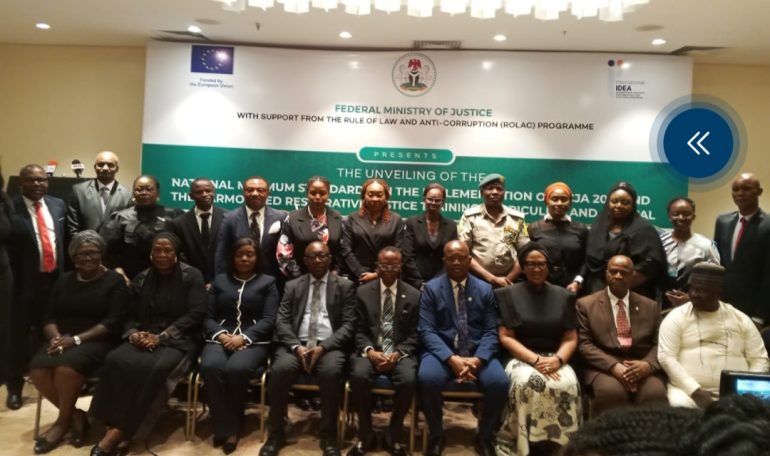
“The National Minimum Standards (2025), which we also unveil today, represent a critical milestone in addressing longstanding challenges in the implementation of the Administration of Criminal Justice Act and similar laws across the States.
Earlier, the Director Administration of Criminal Justice and Reform Department, Federal Ministry of Justice, Mrs Leticia Ayoola-Daniels said the ministry has made notable strides in implementing Restorative Justice (RJ) in FCT, as far back as 2022.
She maintained that in 2023, FMOJ coordinated a meeting with Restorative Justice RJ, Adhoc Committee, Multidoor Court, and facilitators, visiting Lagos State to study their RJ system which led to drafting key documents like Restorative Justice policy, practice direction, and training Manual.”
In a goodwill message, the Chief Judge of the Federal High Court, Justice John Tsoho said it remained an indisputable fact that the Administration of Criminal Justice Act, 2015 serves as an embodiment of a landmark reform in Nigeria’s Criminal Justice System.
Represented by Justice James Omotosho of the Federal High Court, the CJ described the Act as revolutionary in outlook, while maximally promoting efficiency and fairness.
“It has also guarranteed the protection of rights of all parties within the justice process. The establishment of national minimum standards is a giant stride that ensures uniformity in implementation across jurisdictions; strengthens institutional accountability, and enhances public confidence in the justice system.” The CJ said.
There were also goodwill messages from the Chief Judge of the FCT High Court, the Inspector General of Police, the Etsu Kwali, the Chairman of the National Drug Law Enforcement Agency (NDLEA), the Economic and Financial Crimes Commission (EFCC) and the Rule of Law and anti- Corruption (ROLAC) programme at the unveiling ceremony.
Garry Ochigbo, Edited By Grace Namiji


Post comments (0)