Listeners:
Top listeners:
-
 play_arrow
Kapital FM 92.9 The Station that Rocks!


Overcoming Stampedes During Palliative Distribution
In January this year, the World Bank projected that food security will be one critical challenge the global community would grapple with.
This is largely due to human induced factors such as armed conflicts and wars as well as climate change .
It is common knowledge that armed attacks on farmers in parts of the country and flooding for instance have affected farming activities thereby causing food shortage.
The war between Ukraine and Russia has equally had negative impact on global food distribution.
Therefore, in anticipation of this problem, the World Bank recommended putting in place the necessary structure and identifying sufficient resources essential for effective policymaking and developing responsive plans as a way out.
To some extent, the federal government has implemented the recommendation by storing some grains in its reservoirs for the day of reckoning and recently directed the distribution of forty-two thousand metric tons of grains across the country to address the pervasive hunger in the country.
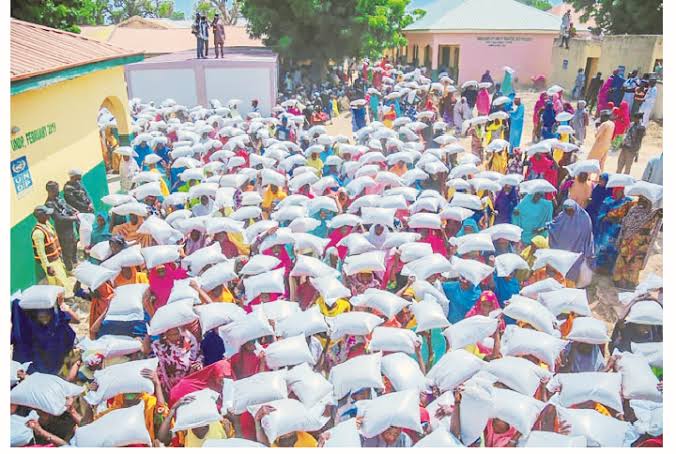
However, the exercise which commenced in Sokoto has been characterized by stampedes, leading to the deaths of citizens.
For instance, nine deaths and 30 injured people were reported in the Sokoto palliative distribution. In Bauchi, no fewer than four people, including women, lost their lives along with scores of others who were injured in a stampede during food distribution.
According to the State Police Command, the tragedy occurred when hundreds of young men and women scampered for the food being distributed.
Few days before the Bauchi tragedy, two female students at the Nasarawa State University in Keffi also died while 17 other students were injured during a stampede inside a hall on the campus where bags of rice were kept.
Students of tertiary institutions in the state were to receive 7.5kg bags of rice and 5,000 naira each as ‘palliatives’ to cushion the effect of the difficult times in the country.
Again, seven people died in Lagos State on 23 February during the distribution of 25kg bags of rice at a discounted price of N10,000 by the Nigeria Customs Service.
The ugly situation made the service to suspend the exercise.
These are just but a few incidences which goes to show the level of hunger and attendant desperation for food by vulnerable Nigerians.
It must be noted that, one of the basic obligations of the government to the citizens is welfare which includes food sufficiency for citizens.
It is therefore apparent that the government must review its policies to ensure food security . First, the government must be decisive in tackling insecurity to pave the way for farmers to go back to farms.
It must be noted that not everyone rely on palliative but due to circumstances as a result of government omission and commission, they have been rendered dependent on palliative.
Again, the government must provide every necessary assistance to farmers such as improved seedlings and timely distribution of fertilizers at highly subsidized rates for them to have bumper harvest and make farming attractive.
In the event that palliative must be distributed, the government must respect the dignity of citizens by planning adequately for decent distribution.
Also, politicians must desist from using the people’s vulnerability to grandstand.
They should clearly profile those they want to reach out to, and evolve seamless plans for such distribution without seeking undue public attention.
It should be noted that, the fact that citizens die in the name of palliative distribution, makes the whole essence of the exercise counterproductive.
Therefore, every modality should be put in place for citizens not to be consumed while struggling for what to be consumed.
By Tersoo Zamber, Edited By Grace Namiji


Post comments (0)