


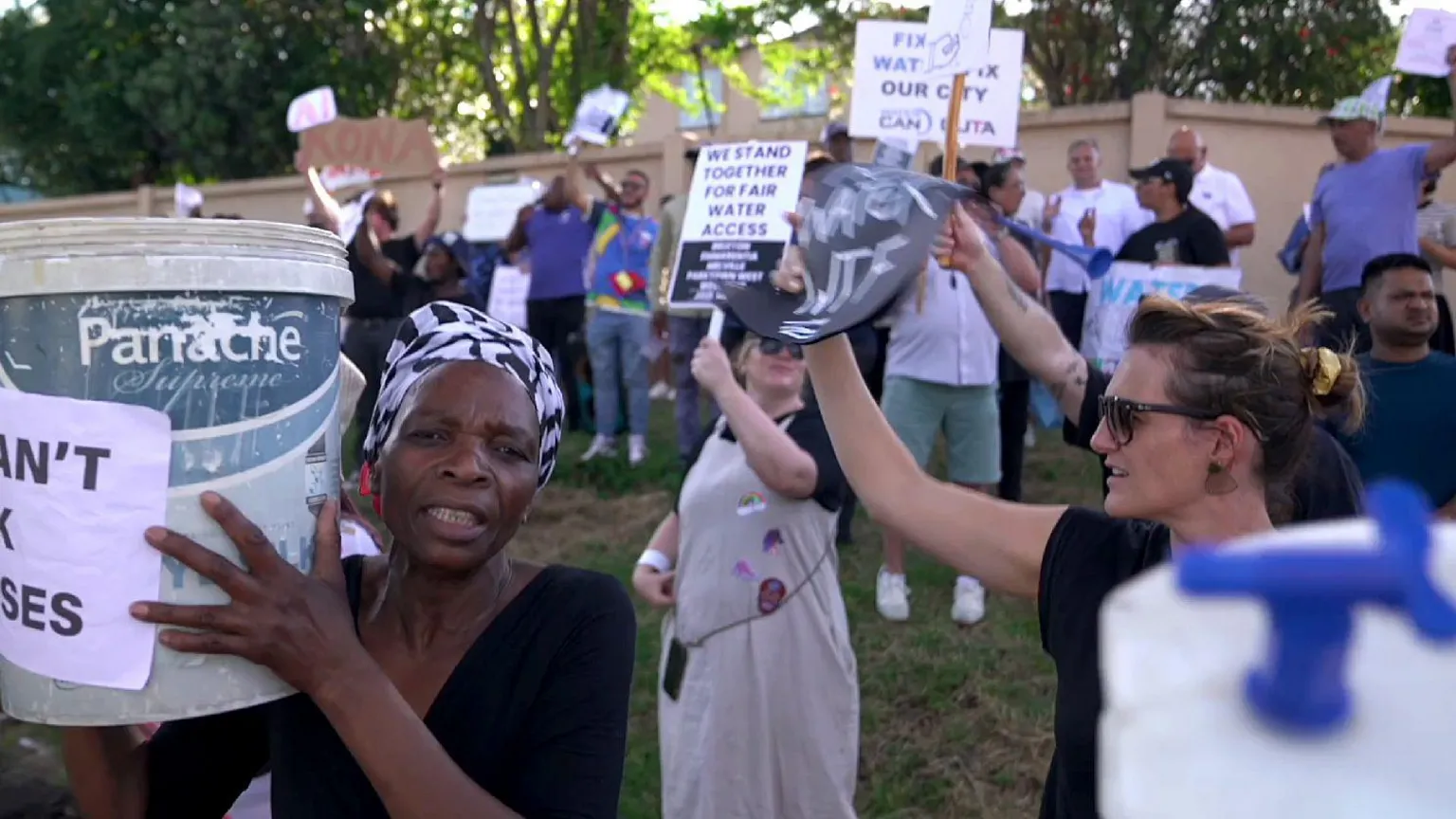
“We want water, we want water!” they chant.
Northern Johannesburg is known for its plush leafy suburbs. But after years of intermittent water shortages, residents say they are fed up. Some have had no running water for over a month.
“Our pipes have been bone dry with no water coming through at all,” says Colin Regesky, who lives in Green Hill. “It’s not very healthy because everyone can get sick with no running water. And also according to the constitution it’s our right to have water.”
Another protester, Jenny Gillies, has lived in Melville for 40 years. “I am here today because it is an actual disgrace,” she says. “We are reduced to begging and protesting for water.”
From 2022 to early 2024, Johannesburg, South Africa’s economic hub, suffered crippling electricity shortages, which were managed via a process known as load shedding.
Blackouts lasting up to eight hours a day severely disrupted the lives of ordinary South Africans and businesses. Experts blame a long-standing lack of investment in the country’s ageing power stations.
But over the past year, water shortages have become a greater concern, with some residents saying these are worse because of how essential clean water is for good health.
And Johannesburg isn’t the only area affected. In Hammanskraal, more than 100km (60 miles) north of the city, 35-year-old pastor Tshepo Mahlaule shows us a dry tap in his backyard.
“This is what is happening in Hammanskraal, there’s no water. People are striving for water. For two months there’s no water. Our kids need to wash every day, their uniforms need to be washed and we have no water.”
The residents of the township have not had reliable access to clean water for over a decade, on and off.
The municipality has resorted to paying for tankers to deliver drinking water to residents. The local opposition Democratic Alliance has accused criminal syndicates known as water mafias of monopolising the water tanker industry – but didn’t provide any evidence to the BBC that this was happening.
“Water mafias are people that get tenders to do work for the municipality,” explains Dr Ferrial Adam, who is the executive director of Watercan, a non-profit that works to safeguard South Africa’s water resources.
“Then either they don’t have the expertise, or once they get hold of a tender to provide an alternative supply of water, they don’t want the tender to end, so they damage and vandalise infrastructure so that they can continue working.
“And then you also have the ones that are charging people for water where they shouldn’t be.”
BBC
Post comments (0)