Listeners:
Top listeners:
-
 play_arrow
Kapital FM 92.9 The Station that Rocks!


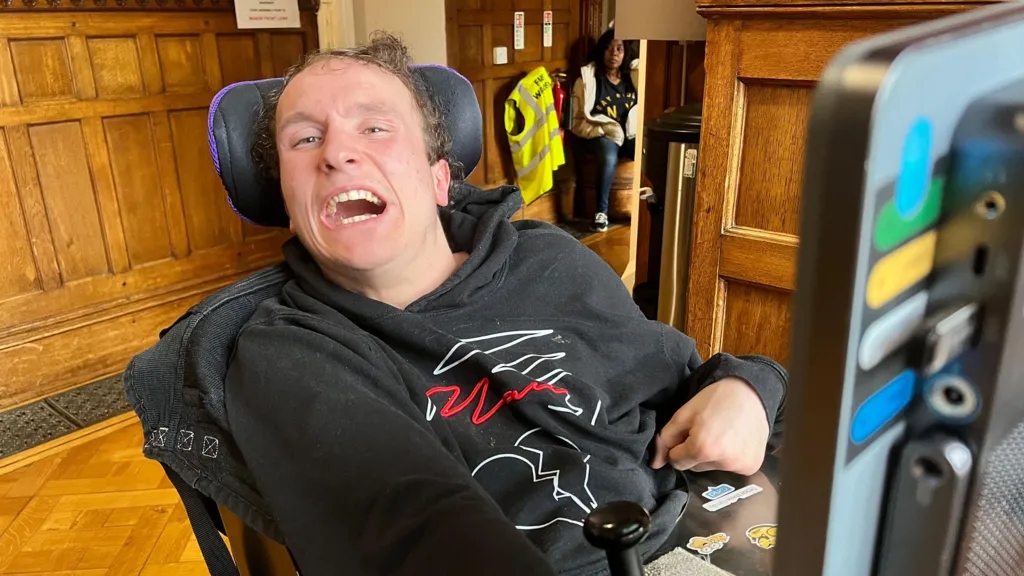
People with disabilities who use technology to communicate and carry out everyday tasks say they want it to become more personalised and versatile.
Students at National Star College in Gloucestershire met executives from a global tech company to talk about how AAC (Augmentative and Alternative Communication) devices can improve.
Aid Holmes told the delegates from Smartbox that he used to hate his AAC as a child, but it has since become an essential part of his life.
“Now I take my AAC everywhere I go because I feel naked without it. It would be like someone ripping your voice box out of your body. This is my voice.”
Mr Holmes said a simple solution that would make a big difference would be an AAC device which lasts for 24 hours, “so I can talk all day without charging”.
AACs are varied but many work by people programming phrases using a screen.
It can then create phrases using an artificial voice, operate computers and apps or control devices where they live.
Hannah Hadley has cerebral palsy and controls her device using what is known as Eye Gaze – which tracks her eye movements to navigate the screen.
She told the panel that she would like an app to run her a bath for a sense of independence, and to use her device to pursue her dream of designing adapted fairground rides for disabled people.
BBC

Post comments (0)