Listeners:
Top listeners:
-
 play_arrow
Kapital FM 92.9 The Station that Rocks!


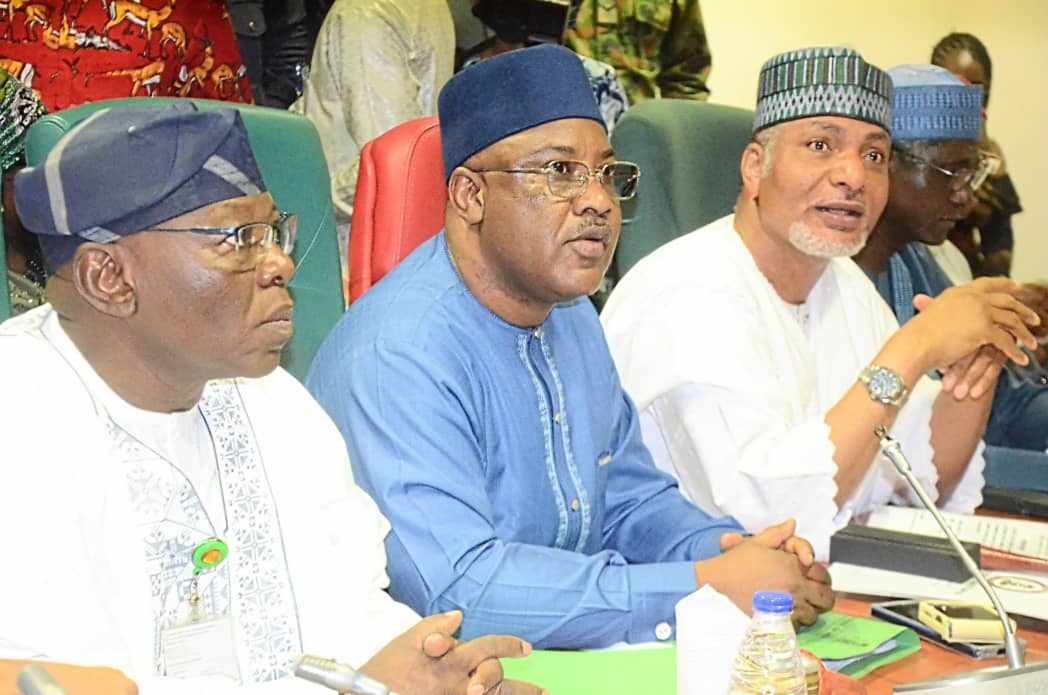
The Chairman of the House of Representatives Committee on Agricultural Production and Services, Bello Ka’oje, has warned that a cut in the funding for the agricultural sector could undermine Nigeria’s food security ambition and weaken economic recovery efforts.
He stated this at a joint budget defence session of the Senate and House of Representatives with the Minister of State for Agriculture and Food Security
Senator Aliyu Abdullahi.
According to him, agriculture remains central to national stability, serving as the primary driver of food security, employment generation, poverty reduction, and sustainable development.
He said the performance of the sector directly affects the welfare of households across the country, particularly under the prevailing economic conditions.
Ka’oje said the committee’s review would be guided by the Renewed Hope Agenda of President Bola Tinubu, with a central focus on how public resources are being translated into actionable strategies capable of delivering food self-sufficiency, mechanisation, youth empowerment, and import substitution.
He noted that while total planned national expenditure is projected to rise by 21 per cent to ₦58.47 trillion in 2026, the allocation to the Federal Ministry of Agriculture and Food Security has declined sharply from ₦2.22 trillion in 2025 to ₦1.45 trillion in the 2026 proposal.
He further observed that allocations to agencies operating under the National Agricultural Technology and Innovation Plan and the National Agricultural Sector Investment Plan have also been reduced by more than 15 per cent.
According to Ka’oje, the reduction threatens to weaken the sector at a time when agriculture is expected to play a leading role in driving the projected 4.7 per cent economic growth in 2026.
Chairman of the Senate Committee on Agriculture, Production and Rural Development, Senator Saliu Mustapha, in his reaction said low implementation of capital projects in the 2025 budget had constrained productivity in the sector.
He noted that while total national expenditure is projected to rise to ₦58.47 trillion in 2026, allocation to the agriculture ministry declined from ₦2.22 trillion in 2025 to ₦1.45 trillion, warning that insufficient funding could worsen food insecurity and undermine economic recovery.
He said agriculture remains Nigeria’s most viable pathway to poverty reduction and employment generation, stressing that strengthened implementation and predictable funding are essential to stabilise the nation’s food system.
He assured that the National Assembly would work with the ministry to ensure the 2026 budget delivers tangible benefits for Nigerians.
In his presentation, the Minister of State for Agriculture and Food Security, Senator Aliyu Abdullahi, said government interventions are focused on expanding production, improving sustainability, and stabilising the nation’s food system.
He said the ministry’s strategy is anchored on the food security emergency declared by President Bola Tinubu, with emphasis on scaling agricultural output across value chains and strengthening the resilience of farmers.
He thanked lawmakers for their continued support to the ministry through successive budget cycles and reaffirmed the ministry’s commitment to prudent utilisation of public resources.
According to him, despite prevailing financial constraints, Nigerian farmers have shown strong commitment to production, with government surveys indicating marginal increases in output.
He noted, however, that sustaining those gains requires addressing the structural challenges confronting producers nationwide.
He told the joint committee that the ministry had submitted its Agricultural Performance in Nigeria report covering 2024 and 2025 to provide lawmakers with evidence of ongoing interventions and outcomes across the sector.
On budget implementation, Abdullahi explained that personnel expenditure under the 2025 appropriation was largely implemented, but capital project execution has been significantly constrained by delayed releases. “For the main ministry, about 30 per cent of the capital allocation, representing roughly ₦18 billion, is yet to be released.”
He added that only funds tied to constituency-related projects have seen partial disbursement, with about ₦19.8 billion released so far.
He said the limited capital releases have slowed programme execution and restricted the ministry’s capacity to scale support for farmers and production systems.
For the 2026 fiscal year, Abdullahi said the agricultural sector is projected to receive about ₦1 trillion in total allocation.
“Within this envelope, the Federal Ministry of Agriculture and Food Security is expected to receive approximately ₦262 billion for capital expenditure and about ₦19.18 billion for recurrent costs, including personnel and overheads.”
Oduyemi Odumade, Edited By Grace Namiji


Post comments (0)