Listeners:
Top listeners:
-
 play_arrow
Kapital FM 92.9 The Station that Rocks!


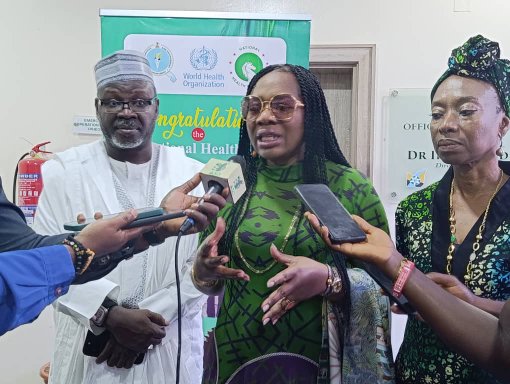
The Federal Capital Territory (FCT) Health Secretariat has called for a significant expansion of the National Health Fellows Programme, citing its growing impact on data-driven planning, service delivery, and human resource strengthening at the primary healthcare level.
Mandate Secretary of the FCT Health Secretariat, Dr. Adedolapo Fasawe, said the first cohort of health fellows has played a critical role in improving data collection, uploading, feedback, and evidence-based decision-making across FCT health projects, making processes more efficient and responsive.
According to her, the fellows have enabled effective task shifting, taking on responsibilities traditionally handled by senior health professionals, following intensive training, exposure, and education tailored to the local terrain and health-seeking behaviour of communities.
Dr. Fasawe emphasized that insisting on fellows being residents of their respective area councils has strengthened community trust, communication, and programme acceptance, adding that the initiative supports the FCT’s overstretched human resource base in the health sector.
“The health fellows have constantly made data collection, not only collection, uploading, sending it to the right place and getting response back. They have made that more efficient in the FCT”.
“We insisted that all the people that will support our health systems here must be residents of here, so that they know the terrain, they know the language, they know the health-seeking behaviour.”
Dr Adedolapo expressed optimism that the 2026 intake would bring more fellows into the system, describing the programme as a timely intervention in addressing Nigeria’s human resource for health challenges, while calling for measurable and verifiable indicators to assess impact.
Permanent Secretary, FCT Health Secretariat, Dr. Babagana, described the programme as already impactful but inadequate for the FCT, noting that six fellows, one per area council, are insufficient for a territory spanning over 8,000 square kilometres with 62 wards.
He appealed for an increase from six to at least 18 fellows, arguing that Abuja Municipal Area Council alone requires multiple fellows due to its population size and geographic spread, while reaffirming FCT’s confidence in the National Health Fellows initiative.
“For us in the FCT, we are still calling for an increase from six to a higher number because the system as we have it now, the number of fellows is the number of area councils you have.Honestly, if we can have like trice or double, it will help us. Now we have six, we can have 18.”
Dr. Babagana also highlighted improvements under the Sector-Wide Approach (SWAP), including upgrades to over 300 primary healthcare centres, expansion of Basic Healthcare Provision Fund-supported facilities, and increased health insurance enrolment, which exceeded targets in both 2024 and 2025.
Acting Director of Health Planning, Research and Statistics, Dr. Teresa Ekaite Nwachukwu, explained that the fellowship selection process is transparent, automated, and merit-based, with no political influence, producing one fellow per area council after rigorous screening.
“You don’t need to know anybody. We don’t know any of these candidates and they don’t know us.As long as you have the qualification, the integrity, the leadership capacity to serve, then you are a candidate.”
She added that fellows are expected to bridge gaps between communities, facilities, area councils, and higher levels of government by collecting data, mentoring health workers, and feeding real-time community challenges into policy and planning frameworks.
Representing the World Health Organization (WHO), Dr. Mary Brentwell, who observed the interviews, commended the diversity of candidates, the balance of the interview panel, and the fairness of the process, noting that the fellows possess varied skills capable of strengthening the health system.
“Looking at the candidates that have been presented here, it’s a wide range of candidates with different skill sets.I think it’s a fair process that is going on, giving the young people who are presented here the chance to explain themselves, to showcase what they can bring to the health sector.”
One of the candidates, Saidu Bello Karshi from Abuja Municipal Area Council, described the interview as seamless and expressed hope that the programme would enable him to contribute meaningfully to community health improvement.
The second cohort interviews mark another step in the Federal Government’s Renewed Hope health agenda, with FCT 2026 expressing confidence that expanding the fellowship will further strengthen primary healthcare delivery and reduce pressure on secondary and tertiary health facilities.
Remi Johnson, Edited By Grace Namiji


Post comments (0)