Listeners:
Top listeners:
-
 play_arrow
Kapital FM 92.9 The Station that Rocks!


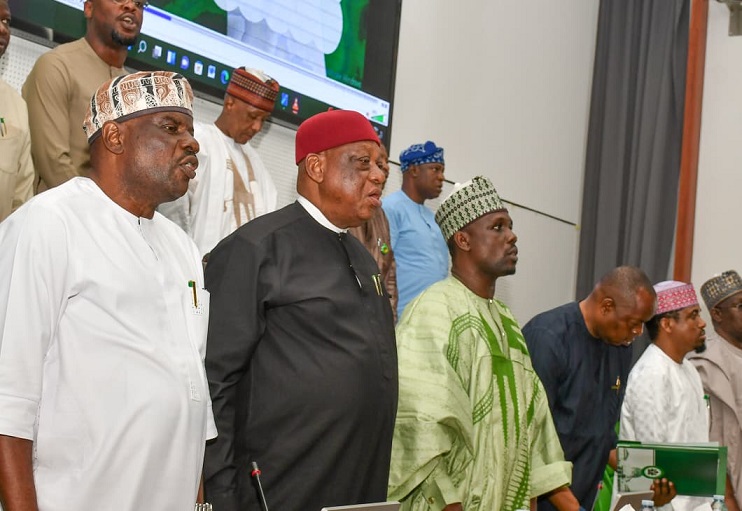
The House of Representatives Committee on National Security and intelligence has begun moves to regulate private intelligence and investigation services as part of broader efforts to strengthen the country’s security system.
At a public hearing on the Private Intelligence and Investigation Council Bill, 2024, organized by the House Committee on National Security and Intelligence,
Chairman of the Committee, Ahmed Satomi said the proposed bill would establish a legal framework to oversee private security operators, improve accountability, and promote closer cooperation with public agencies.
Satomi who is also the sponsor of the bill, said it would help professionalise the private intelligence industry and address gaps in coordination that have long undermined Nigeria’s security architecture.
He noted that the initiative comes at a time when Nigeria is confronted with a web of security challenges ranging from insurgency and banditry to cybercrime and kidnapping, stressing that innovative approaches are required to strengthen the country’s security infrastructure.
Citing recent data, Satomi said the Nigerian Bureau of Statistics (NBS) reported over 51.89 million household crime incidents between May 2023 and April 2024, with kidnapping alone accounting for 2.23 million incidents and ₦2.23 trillion paid in ransoms during the same period.
“These figures,” he said, “underscore the magnitude of the security threats confronting our nation and the need for all stakeholders, governmental and private, to work collaboratively. Security, as it is often said, is everyone’s business.”
The lawmaker emphasized that while the efforts of Nigeria’s security agencies are commendable, the evolving nature of threats demands additional layers of support, regulation, and intelligence coordination. He said the bill aligns with the National Assembly’s legislative efforts to address security concerns through proactive, intelligence-driven reforms.
According to him, the benefits of the bill are extensive. Beyond establishing a council to accredit private intelligence and investigation services, it seeks to streamline compliance mechanisms, enforce ethical standards, and create partnerships between public and private security agencies for improved outcomes.
However, Satomi acknowledged that not all stakeholders fully agree on every provision of the proposed legislation and disclosed that while many of the submissions received by the Committee were supportive, some expressed concerns regarding possible overlaps with existing laws and the mandates of established security institutions.
“For instance,” he said, “there is a concern that upholding Section 1(3)(a–f) of the Bill as it stands may dilute the exclusive statutory responsibility of an agency in matters of security clearance and internal vetting. Another concern referenced Section 4(i) of the Nigeria Police Act, 2020, warning that the bill may create duplication, legal disputes, and confusion over authority.”
He noted that these differences reveal deeper institutional issues within Nigeria’s security ecosystem, particularly the long-standing challenge of poor inter-agency collaboration and inefficient intelligence sharing
Declaring the Public hearing Open, Speaker of the House Dr, Abbas, Tajudeen, urged decisive legislative action toward establishing a multi-level policing system in Nigeria, describing it as a necessary step to address the country’s security challenges.
He said security reforms have become a national priority and must now move from “theory to decisive action.”
The Speaker, who was presented by the member representing Ilorin West/Asa Federal Constituency, Muktar Shagaya, said creating state police through constitutional amendment remains a viable option deserving serious national consideration.
He also emphasized the need to strengthen community policing as provided in the Police Act 2020 to make it more effective and responsive to local realities.
Abbas said the House remains committed to reforms that will enhance public safety and strengthen Nigeria’s overall security architecture.
According to him, the National Assembly’s focus on security-related legislation, including the proposed Private Intelligence and Investigation Council Bill, underscores its determination to provide a legal framework that promotes accountability, professionalism, and collaboration among both public and private security actors.
He reaffirmed that the 10th House of Representatives remains committed to transparency, accountability, and inclusiveness in all legislative engagements.
Oduyemi Odumade, Edited By Grace Namiji
Post comments (0)