Listeners:
Top listeners:
-
 play_arrow
Kapital FM 92.9 The Station that Rocks!



Environmental activists, academics, and civil society groups have renewed calls for immediate and radical action to address Nigeria’s escalating ecological crisis, demanding that the National Assembly should enshrine environmental rights in the nation’s constitution through the ongoing constitutional review process.
The call was made at the 2nd Nigeria Socio-ecological Alternatives Convergence, NSAC held in Abuja.
The event, organised by the Health of Mother Earth Foundation HOMEF, brought together participants from across Nigeria, eight African countries, and international environmental justice partners to strategize on transforming Nigeria’s environmental governance framework.
The Executive Director of HOMEF,
Dr. Nnimmo Bassey,
in his opening remarks, warned that Nigeria’s social and ecological fabric is at a breaking point.
He said the widespread threats from desertification, deforestation, extreme pollution, floods, coastal and gully erosion, and agricultural insecurity were so severe that they warranted a declaration of a national environmental security state of emergency.
He urged lawmakers in the 10th National Assembly to seize the opportunity of the constitutional amendment process to make environmental rights justiciable in Nigeria.
“We have examples in South Africa and Kenya where environmental rights are enshrined in their constitutions. In South America, countries like Ecuador and Bolivia recognise the rights of nature,” Bassey stated.
He advocated for the granting of legal personhood status to natural entities such as water bodies, forests, hills, rocks, and wildlife to protect them from exploitation.
“We need to see where the hills of Abuja, including Aso Rock, are granted personhood so people don’t blast them away as if they hold no significance, If we don’t respect nature, it’s a reflection of how little we care about one another and future generations.”
Bassey emphasised that the convergence is pushing for a total overhaul of Nigeria’s environmental governance structure, away from destructive extractive systems and toward a decolonial, post-extractive future that places communities and ecological justice at the centre of development.
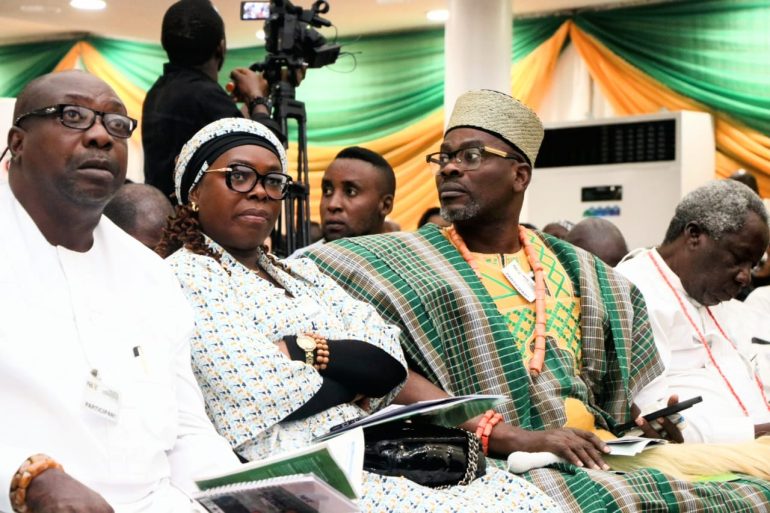
In a keynote address, Professor Emmanuel Oladipo, a climate change expert, underscored the need for a harmonised legal and regulatory framework for addressing Nigeria’s environmental and socio-ecological challenges.
He warned that the continued depletion of the country’s environmental foundations could have dire consequences.
“If the environment collapses, the economy will suffer, the social fabric will weaken, and political stability will be compromised. Development seen purely through the lens of economic growth cannot be sustained indefinitely on a finite planet. We must address environmental degradation and pursue development simultaneously through a comprehensive, integrated national policy agenda.”
The NSAC Charter, unveiled during the event, articulates a bold vision for Nigeria one rooted in ecological integrity, social justice, and economic well-being.
The convergence also reiterated its support for regional legislative efforts, including the Delta State House of Assembly’s move to grant legal personhood to River Ethiope, and referenced existing legal and scientific evidence of ecological harm, such as the 2011 UNEP Report on Ogoniland and the 2023 Bayelsa State Environmental Genocide Report.
The event, described by Bassey as a “collective space for transformation,” emphasized the role of communities in shaping environmental policy.
The 2nd NSAC closed with renewed commitment to building a resilient Nigeria where people and the planet are at the heart of national development.
Aisha Adesanya, Edited By Grace Namiji
Post comments (0)