Listeners:
Top listeners:
-
 play_arrow
Kapital FM 92.9 The Station that Rocks!


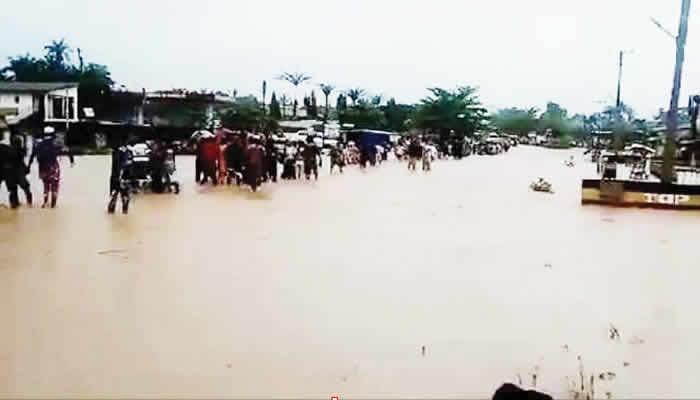
The Nigerian Meteorological Agency has issued a flood alert for the month of July, warning that states including Sokoto, Lagos, Edo, Benue, and 16 others are at risk of experiencing flash floods.
This came as the Africa Environmental Health Organisation, climate change adaptation researchers, and members of the Nigerian Institute of Town Planners, among others, lambasted state governments following the recent devastating floods that ravaged several states, calling for an intense scrutiny over the management of ecological funds allocated to affected regions.
Findings showed that despite receiving over N620bn in ecological funds, many states seem ill-prepared to mitigate the impact of such disasters, raising questions about the effectiveness of these funds in enhancing environmental resilience and disaster preparedness.
NiMet’s flash flood risk alert for July 2025, released on Monday by the agency, showed the states with varying probable risks of experiencing flash flooding events due to the onset of rainfall across the country.
The agency said, “Sokoto State has a high risk of experiencing flash floods. Other states with notable risk of flash flooding are Kaduna, Zamfara, Yobe, Bauchi, Bayelsa, Jigawa, Adamawa, Taraba, Niger, Nasarawa, Benue, Ogun, Ondo, Lagos, Delta, Edo, Cross River, Rivers and Akwa Ibom.”
The agency advised residents of the states to relocate if necessary, clear drainage systems, prepare emergency kits, turn off electricity and gas during flooding, strengthen mudslide prevention, and promote community awareness.
This came as residents of some Ondo communities affected by the flood that occurred last week have called on the state government on Monday to come to their aid following the destruction of their property.
The flood occurred as a result of a downpour on Friday, Saturday, and Sunday, which has reportedly destroyed property worth millions of naira in communities in Owo, Okitipupa, Ilaje, and Ese Odo Local Government Areas of the state.
It was gathered that the flood destroyed buildings and submerged bridges in the affected communities of Uso, Ayeka, Ikoya, Igbodigo, Igodan, and Igbotako.
One of the victims in the Okitipupa community, Mr Joshua Jemiloni, said, “The flooding was caused by erosion flowing down from Igodan, coupled with the fact that the Igodan stream along the road overflowed its banks during the torrential downpour. It affected about 10 buildings.”
Similarly, a community leader in Igbodigo, in Okitipupa Local Government, Lawrence Awanebi, who expressed shock at the level of destruction, also called on the government to urgently assist those rendered homeless by the flood.
Also, the Chairman of Owo Local Government, Tope Omolayo, appealed to the Federal Government, the Ondo State Government, and relevant emergency agencies to intervene swiftly.
The State Governor, Lucky Aiyedatiwa, had earlier said the government had commenced initiatives that would reduce floods and other natural disasters by dredging the waterways across the state.
“As a government, we shall continue with initiatives that will reduce the effects of floods and other natural disasters by dredging our waterways and enforcing environmental sanitation laws,” he stated.
Acoording to reports despite receiving over N620bn in ecological funds, many states seem ill-prepared to mitigate the impact of such disasters, raising questions about the effectiveness of these funds in enhancing environmental resilience and disaster preparedness.
The funds, meant to support environmental sustainability and disaster management initiatives, appear to have fallen short of their intended purpose, leaving communities vulnerable to recurring flood disasters.
Critics argue that the allocation and utilisation of ecological funds should be transparent and subject to regular audits to ensure that the money is being used for its intended purpose. The lack of accountability and oversight in the management of these funds has led to concerns about potential misappropriation and inefficiency.
As the nation grapples with the aftermath of the floods, there is a growing demand for greater transparency and accountability in the management of ecological funds to prevent similar disasters in the future and ensure that affected communities receive the support they need to recover and rebuild.
It was indicated that the 36 states of the federation shared N622.15bn allocations from the Ecology Fund from 2012 to February 2025.
The ecological fund is a crucial part of Nigeria’s federal revenue allocation, specifically designated to address various environmental challenges nationwide, including erosion, desertification, flooding, oil spills, and drought.
Established in 1981, the fund is drawn from the Federation Account at a rate of two per cent, with the primary objective of assisting all tiers of government in tackling ecological problems. The fund’s disbursement process is managed by the Ecological Fund Office, under the Office of the Secretary to the Government of the Federation.
Over 14 years, the Federal Government disbursed a total of N622.15bn from the Ecological Fund to the 36 states of the federation. These disbursements were guided by the severity of environmental challenges experienced across different regions, reflecting efforts to provide equitable support based on need.
According to a recent report by the Nigeria Extractive Industries Transparency Initiative, the enabling legal frameworks have placed the management of the fund under the Secretary to the Government of the Federation, who is empowered to administer and disburse the funds in line with directives from time to time.
It stated, “Our review of revenue allocated to the fund showed that the total amount allocated and received by the fund from December 2011 (was shared in 2012) to November 2016 was N277bn.”
Subsequently, from 2017 to 2022, a total of N300bn was distributed among the 36 states, based on data from the distribution of ecology revenue allocation to states by the Federation Account Allocation Committee.
In the most recent disbursement cycle from June 2023 to June 2024, the states collectively received N39.62bn, data from the Federation Account Allocation Committee published by the National Bureau of Statistics revealed.
For January 2025, which was disbursed in February 2025, the FAAC report indicated a total allocation of N6.03bn to the states. Of this, Kano State received the highest share of N2.5bn, followed by Lagos State at N2.1bn, and Borno State, which faces extensive environmental degradation due to insurgency, received N1.97bn, while Niger State got N1.8bn.
Mokwa’s district head, Muhammad Shaba Aliyu, said it has been 60 years since the community had suffered that degree of flooding. “I beg the government to support us,” Aliyu had said.
Meanwhile, a June 2025 report by SBM Intelligence revealed that since July 2024, floods have inundated 31 of Nigeria’s 36 states, affecting approximately 1.2 million people. The deluge has also destroyed an estimated 180,000 hectares of cultivated farmland, dealing a severe blow to the country’s agricultural productivity.
The report, published in June 2025, stated that since July 2024, 31 of Nigeria’s 36 states have been inundated by floods, affecting approximately 1.2 million people. It read, “Since July 2024, 31 of Nigeria’s 36 states have been inundated by floods, affecting approximately 1.2 million people. This widespread deluge has destroyed an estimated 180,000 cultivated farmlands nationwide.”
The floods have caused significant damage to agricultural infrastructure, further exacerbating food insecurity. The Middle Belt, known for its agricultural output, has seen widespread destruction of crops, contributing to food price inflation, which reached 35.41 per cent in January 2024.
Authorities in Nigeria have issued flood alerts and warned of heavy downpours in at least 15 of the country’s 36 states, including Niger State. These warnings were issued by the Nigerian Meteorological Agency and the National Emergency Management Agency.
Reacting to the development, the President of the Africa Environmental Health Organisation, Afolabi Abiodun, said the government claims to be trying, but the impact is not felt.

Post comments (0)