Listeners:
Top listeners:
-
 play_arrow
Kapital FM 92.9 The Station that Rocks!


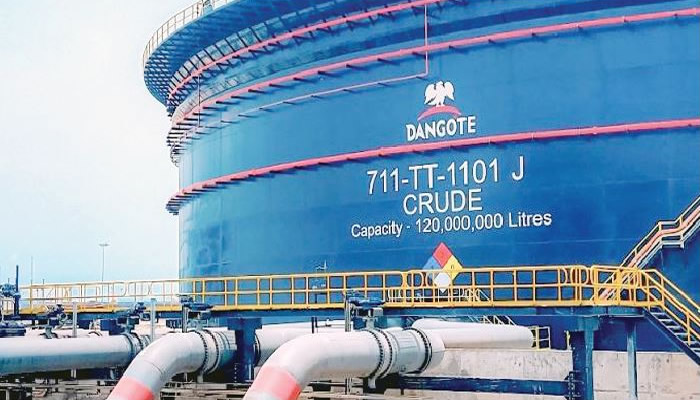
The Dangote Petroleum Refinery and some modular refineries in Nigeria may spend about $8.56bn to import an estimated 122,400,000 barrels of crude oil to achieve full operational capacity in six months.
Accoding to reports, this means the refiners may spend about $1.43bn monthly on the importation of crude oil into Nigeria.
The plants may spend this much amid the uncertainty surrounding the sustainability of the naira-for-crude policy between the Nigerian National Petroleum Company Limited and the Dangote refinery, coupled with concerns about the Domestic Crude Supply Obligation of the Federal Government.
This came as it was discovered that the meeting that was earlier scheduled on Monday between the Technical Sub-Committee on the Naira-for-Crude Policy, Dangote refinery, and other government officials did not hold as planned.
Insiders familiar with the workings of the committee said the meeting was rescheduled and may be held before the Sallah break.
“The NUPRC (Nigerian Petroleum Upstream Regulatory Commission) is not done with the assignment given to it by the committee. Hence, the meeting could not be held today.
“They are asking for more time. Hopefully, the committee can reconvene before the Sallah holiday,” a senior government official who works with the committee told our correspondent in confidence due to the lack of authorisation to speak on the matter.
The Dangote refinery has a capacity of 650,000 barrels per day, and the plant had repeatedly made it known that it was importing and would continue to import crude. With the latest uncertainty in the naira-for-crude deal, the plant would rely heavily on imported crude.
Another domestic refinery that is also making efforts to import crude from the US is the Edo Refinery, with a capacity of 30,000 barrels per day. The plant has sought product offtake from a US-based crude supplier, according to information from modular refiners on Monday.
It was further gathered that while other modular refineries were making alternative plans to get the commodity, the Dangote and Edo refineries would require about 680,000bpd crude daily.
This translates to about 20.4 million barrels in 30 days (one month), and 122.4 million barrels in six months. At the average cost of $70/barrel for Brent crude, it means the two plants may spend about $8.56bn to import the commodity in six months.
The National Publicity Secretary of the Crude Oil Refinery-owners Association of Nigeria, Eche Idoko, in an exclusive interview on Monday, stated that sourcing raw materials from alternative suppliers remains their sole viable option for refiners.
He said domestic refiners now find themselves effectively stranded due to the government’s failure to ensure product offtake under the domestic supply obligation or the naira-based agreement.
He revealed that the situation has forced the 30,000 Edo refinery to deepen discussions with a crude supplier from the United States of America to secure an offtake deal.
He said other refineries that don’t have the financial muscle are no longer operational.
Idoko said, “Edo refinery, which is trying to expand its plant to 30,000 barrels per day, is in talks with crude suppliers from the United States. Others, apart from Walter Smith refinery and Aradel, who are momentarily relying on crude produced from their fields, are more or less stranded. Other modular refineries have not been able to refine a litre in the last six to eight months.”
Currently, modular refineries operating in the country include the Walter Smith modular refinery, Aradel, the Omsa Pillar Astex Company refinery, the Edo refinery and the Duport modular refinery. Clairgold and Azikel refineries are at an advanced stage in their construction.
Idoko emphasised that the government’s failure to allocate sufficient feedstock represents a major setback to its efforts to stabilise the sector and carries significant political consequences.
The national officer added, “Let it be clear that the news of Dangote or any local refinery procuring crude offshore through import as a result of failure or inability to source locally is a major dent in the efforts of this government to stabilise the sector.
“Whoever is frustrating the supply of crude to the local refinery is an enemy of this government and arming opposition with weapons ahead of the 2027 elections because the manner investors in local refining, including the Dangote refinery, have been treated would definitely be a factor to consider in the coming elections.”
The local refiners decried the difficult situation that had confronted them since last week after the abrupt alleged cancellation of the first phase of the naira-for-crude arrangement.The refiners said they had anticipated being included in the second phase of the naira-for-crude deal after a successful pilot phase with the 650,000 barrels per day capacity Dangote refinery.
Sources, speaking on condition of anonymity due to a lack of authorization to discuss the matter, revealed that talks broke down because of issues related to crude availability from the Nigerian National Petroleum Company Limited.
Insiders familiar with the development said the national oil firm had allocated large volumes of crude to its foreign creditors to settle the loans acquired by the firm, making it difficult to sustain the naira-for-crude deal between NNPCL and Dangote refinery.
Analysed reports from the Nigeria Extractive Industries Transparency Initiative and the 2023 NNPC financial statements, had shown that 8.17 million barrels of crude had been pledged for different loan deals by the national oil firm monthly, with an additional $9.5bn forward oil sales deal in the offing.
In response to failed talks, the Dangote Petroleum Refinery announced a temporary halt in the sale of petroleum products in naira, citing an imbalance between its sales proceeds and crude oil purchase obligations, which are denominated in US dollars.
The company explained that its naira-denominated sales had exceeded the value of naira-priced crude it had received so far. As a result, it decided to temporarily align its sales currency with its crude procurement obligations.
“Dear valued customers, we wish to inform you that the Dangote Petroleum Refinery has temporarily halted the sale of petroleum products in naira. This decision is necessary to avoid a mismatch between our sales proceeds and our crude oil purchase obligations, which are currently denominated in US dollars.


Post comments (0)