Listeners:
Top listeners:
-
 play_arrow
Kapital FM 92.9 The Station that Rocks!


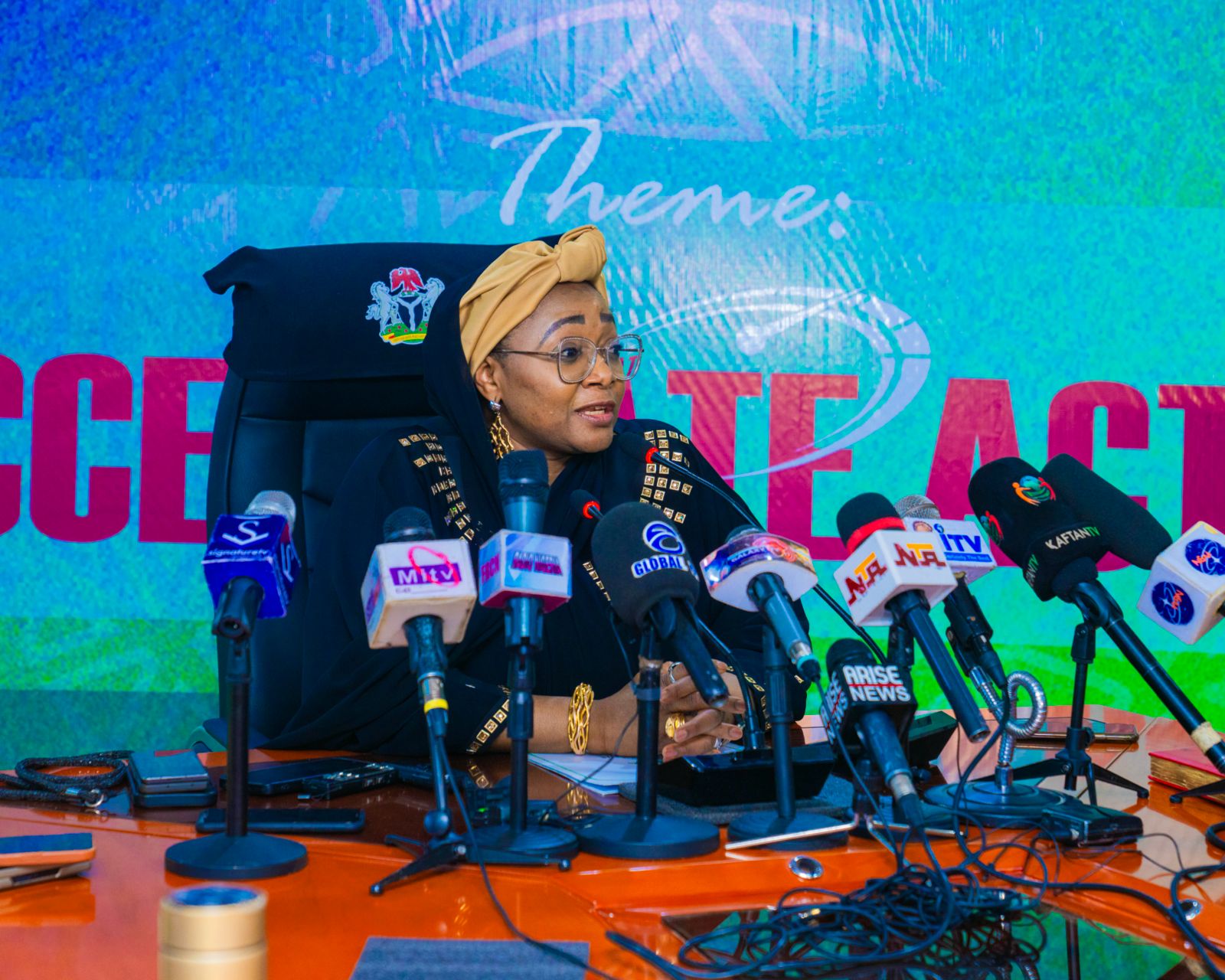
As a build up to the International Women’s Day 2025, the Honourable Minister of women Affairs, Hajiya Imaan Sulaiman-Ibrahim during a press briefing on Thursday March 6th, officially flagged off the day under the theme “Accelerate Action”, honouring the matriarchs of the nation, marking 30 years of Beijing, 30 years of the establishment of the Federal Ministry of Women’s Affairs, identifying major dimensions to issues that Nigerian women must overcome but also announcing the landmark decision which signals a new era of government commitment to institutionalizing women’s empowerment as a core pillar of national development.
The Honourable Minister said the commemoration was a critical moment to propel gender equality into tangible and measurable progress. It is a rallying call for deliberate, decisive, and bold action to break barriers, close gaps, and empower Nigerian women and girls to take their rightful place in every sphere of our society.
Below is the rest of the statement and the four challenges.
2. As you may be aware, International Women’s Day is a global observance that dates back to the early 1900s, born out of the struggles of women for equality, better working conditions, and the right to vote. Over the years, it has evolved into a day not just for celebration, but for reflection, advocacy, and action in the pursuit of gender equality. For Nigeria, this day holds profound significance as we recognize the remarkable contributions of women to national development while acknowledging the persistent challenges they continue to face.
3. As you are aware, this year, we also celebrate 30 years of the existence of the Federal Ministry of Women Affairs as a vital institutional mechanism for the advancement of the Nigeria Gender Agenda; an institutional legacy of the Beijing Platform for Action, one of the most transformative global frameworks for gender equality.
4. We cannot talk about progress without acknowledging those who paved the way. As we mark this milestone, we must honor the fearless women who stood against oppression and injustice, from pre-independence trailblazers like Chief Margaret Ekpo, Chief (Mrs.) Funmilayo Ransome-Kuti, and Hajiya Gambo Sawaba, to the thousands of women who laid down their lives in protests such as the Aba Women’s Riot of 1929 and the Egba Women’s Revolt of 1947.
5. We also remember the legacies of Her Excellency Dr. Maryam Abacha, who led Nigeria’s delegation to the 1995 Beijing Conference, and Her Excellency Dr. (Mrs.) Maryam Babangida, whose Better Life Programme for Rural Women revolutionized grassroots empowerment. Their work reminds us that change is not given; it is demanded and earned through persistence and resilience.
6. Today, as I serve as Nigeria’s Minister of Women Affairs, I do so with the knowledge that this Ministry has come of age, standing at the forefront of policy formulation, advocacy, and institutional reforms for gender equality. Our modern headquarters may be a physical symbol of progress, but the real work lies in translating policies into action, ensuring that women, girls, and vulnerable populations have access to justice, economic empowerment, and equal opportunities.
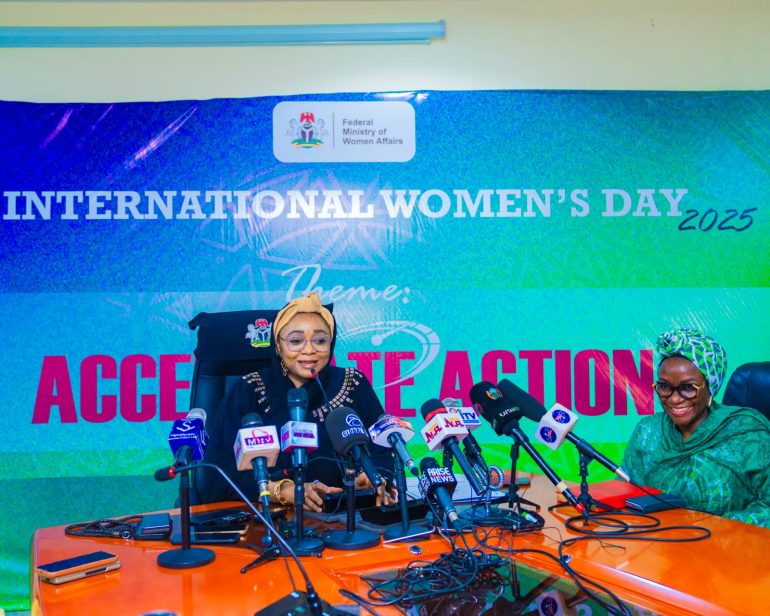
7. However, the journey is far from over. There are four dimensions to the issues that continue to confront us.
-
First, the legal and policy framework. While Nigeria has made significant progress in enacting gender-responsive laws such as the Violence Against Persons (Prohibition) Act (VAPP) and the Child Rights Act, full implementation remains a challenge. As of today, 35 states have domesticated the VAPP Act, while 34 states have adopted the Child Rights Act – a step in the right direction but not yet enough. We need full compliance, effective enforcement, and accountability to ensure that the rights enshrined in these laws are a lived reality for every Nigerian woman and girl.
-
Second, economic empowerment. Women drive Nigeria’s informal economy, owning 41% of Micro, Small, and Medium Enterprises (MSMEs). However, access to finance, markets, and digital literacy remains a barrier to scaling their businesses. More than 94% of women still lack access to formal credit despite their proven ability to reinvest in their families and communities. We must close the gender financing gap, expand opportunities in trade, technology, and digital skills, and provide structured support for women entrepreneurs. Under the Nigeria for Women Project Scale Up project, which we just commenced, we will be reaching a minimum of 4.5 million women nationwide to bridge the gap. We also launched the MOWA-SARA initiative recently, with support of WEMA Bank. As we speak today, this skill development programme is ongoing, and the target is 500,000 women.
-
The third, is gender-based violence and social norms. Over 30% of Nigerian women aged 15-49 have experienced physical violence, and one in four girls has been sexually abused before age 18. We recently witnessed the tragic deaths of Emrich Effanga in Cross River State and Mutiat Sholola in Ogun State; the heartbreaking case of the 24-year-old Salome Adaidu, killed in Nasarawa State; the Mother of 6, whose husband allegedly poured petrol on her and set her ablaze in Anambra State; and the woman whose fingers were chipped off by her supposed boyfriend in Dei-Dei Community, Federal Capital Territory, amongst others. These are stark reminders of the urgent need to sustain the declaration of the state of emergency on gender-based violence embarked upon in 2020 by the Nigeria’s Governors Forum in the wake of high number of such cases in the midst of lockdown of COVID-19. These are not isolated incidents, but part of a larger pattern of violence that must be decisively addressed. Harmful traditional practices such as child marriage and female genital mutilation (FGM) persist, with Nigeria ranking third globally in child marriage prevalence – a statistic that should alarm us all. The Ministry remains unwavering in its commitment to strengthening survivor-centered services, and we are pushing for the review of Child Rights Act and the VAPP Act, and creating safe spaces across the country. This is not just a women’s issue; it is a national crisis that undermines our collective development.
-
Fourth is political representation and leadership. Women remain vastly underrepresented in decision-making spaces. In our 10th National Assembly, only 4 out of 109 Senators and 17 out of 360 House of Representatives members are women, with 15 states lacking any female representation. This stark imbalance is not reflective of a progressive democracy. We must accelerate efforts toward political inclusion, ensuring that women have a seat at the table – not as tokens, but as equal partners in governance and development.
8. Accelerating action demands that we confront the harsh realities facing women and girls in Nigeria today. For too long, our interventions have been largely dependent on donor funding; an approach that, while helpful, is neither sustainable nor sufficient. True transformation requires nationally owned investments. This is why we commend His Excellency President Bola Ahmed Tinubu GCFR, who has, for the first time in the history of the Ministry, significantly raised its budget. This landmark decision signals a new era of government commitment to institutionalizing women’s empowerment as a core pillar of national development.
9. With these increased resources, we will prioritize the resuscitation of one of the Ministry’s legacy project, the National electronic dashboard launched as part of a collaboration between the Federal Ministry of Women Affairs under the European Union-United Nations (EU-UN) Spotlight Initiative to provide comprehensive data to help tackle gender-based violence in November 2020 and the inter-ministerial technical committee on GBV, we will expand programmes on women’s economic empowerment, promote digital skills acquisition for girls, scale up family cohesion programmes, revitalize child protection and participation and unlock new opportunities for women through the African Continental Free Trade Area (AfCFTA), amongst others. We will prioritize legislative advocacy, the economic empowerment of women, girls’ education, and the fight against gender-based violence.
- In a few days, I will lead a diverse delegation of Nigerians to the UN Commission on the Status of Women (CSW); the largest global gathering on women’s rights. Our goal is clear:
- To showcase Nigeria’s progress,
- To forge stronger global partnerships, and
- To amplify our collective commitment to gender justice and empowerment.
10. The task before us is immense, but I believe with our collective will and effort, we can accelerate action for a more inclusive and equitable Nigeria. My charge to us is that let us take the opportunity of the International Women’s Day to a time to strengthen our unity, determination, and unwavering commitment to tackling the legacy challenges that have held us from realizing the full potential of Nigerian women and girls.
11. Let me end by thanking His Excellency, President Bola Ahmed Tinubu, GCFR, for prioritizing women’s issues like never before. I also extend my deepest appreciation to all our development partners, civil society organizations, and advocates who continue to push the boundaries for gender equality.
12. To every Nigerian woman and girl: Your time is now. Stand up, step forward, and claim your place in shaping Nigeria’s future.
13. I thank you all for coming, and may God bless the Nigerian Woman, and may God bless the Federal Republic of Nigeria

Post comments (0)